When I was a student seeing practice I used to long for the phone to ring, another patient to arrive and the chance to learn. Since graduation this can be either welcome or unwelcome depending on what is going on and how the shift is looking. Most of the time through normal working hours there is a reception team who do an amazing job at looking after the phones. However out of hours, all bets are off.
Phones out of hours
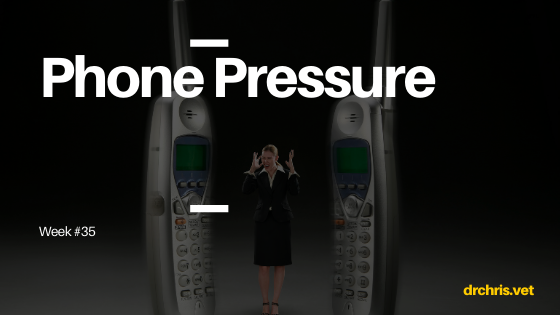
Running an emergency service is expensive. So one of the ways to make this happen is to have minimal staffing. This often means no reception team, and so the phone comes straight through to a vet or nurse. In many places the emergency team only consists of a single vet and nurse. In addition to answering the phone they are looking after patients in kennels, dealing with the patient currently being seen, and may even be operating.
The reality is that the phone can affect patient care. Trying to complete a task with interruptions can mean that things are missed or forgotten. I know at least one occasion where I’ve forgotten to take a patients temperature as the phone has rung and distracted me in the middle of doing so. It can also make simple procedures take longer, meaning that patients are restrained longer, the nurse is tied up assisting instead of doing one of the thousand things they have to do. Especially true with cats who won’t just sit and wait. I once answered a phone three times during the course of examining a patient’s eye. This is an exam that normally without interruptions takes just a few minutes yet took many times longer than this.
There are even times when both the vet and nurse are on the phone, yet it is still ringing. Trying to get it every time as each call could be a patient needing to be seen immediately. Feeling guilty if not able to get to it, yet hoping that if it rings out that a true emergency would call again.
Making a list
During these times my goto is to briefly triage the call and to take name and number on anything not emergent. Anything not urgent will be called back as soon as possible. Sometimes this is pretty quick. Sometimes it can be an hour or so. There’s been occasions where this has resulted in a list of 10+ people to call back over a very short period.
Each and every one of these has called for a reason, and is concerned for their pet. Yet there is only 1 of me. This means that I have to focus where I am most needed. The sickest animals get priority. Those wanting updates on inpatients go to the back of the queue. The dog that cannot breathe gets to the front of the line.
Even getting to the top of the call back list doesn’t mean that there is capacity to see that pet. Some cases can be quick and simple to deal with. Others may need intensive stabilisation or emergency surgery. And if I am doing that then I cannot examine or treat another patient without putting the first at risk. I am not even sure if it would be morally right for me to try and attempt to do so.
Other solutions
One of the practices I worked at previously used a call handling service. This meant that they provided the client details and summary of the problem in a 30-60 second call for us to then call that client back. And if we missed the phone we could then call the answering service back to get details. They also filtered out those that were looking for flea & worming at 1am, or wanting to book vaccinations at 11pm on Friday night.
However my dream would be having a central triage service staffed just to cover the phones. With the ability to then distribute incoming patients depending on capacity across emergency practices. Until then, I can only do my best.
If you have any different strategies for dealing with phone pressure I’d love to hear them – just leave a comment below!